What is an HLS video?
Most video you watch online is not one file. It is a list, and hundreds of small pieces the list points at.
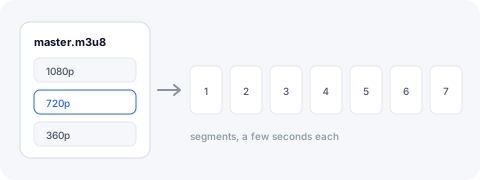
A playlist, not a file
HLS stands for HTTP Live Streaming. Apple published it in 2009 and it is now how most of the web delivers video. Instead of one large file, the video is cut into segments a few seconds long, and a small text file — the playlist, ending in .m3u8 — lists them in order.
Your player reads the playlist, fetches the first few segments, starts playing, and keeps fetching ahead of you. Nothing ever downloads the whole thing, which is the point: playback can start in a second instead of waiting for a 400 MB file.
Why the picture changes while you watch
A real HLS stream carries several complete versions of the same video at different qualities, and a master playlist listing all of them. The player measures how fast segments are arriving and switches between versions between one segment and the next.
That is why a video sharpens a few seconds in, or drops to a blur when you walk out of wifi range, without ever stopping. It is not one stream degrading — it is the player changing which ladder rung it is standing on.
What this means for downloading
There is no address you can right-click and save, because there is no file at the other end of it. A downloader has to read the playlist, choose one quality, fetch every segment in order, and stitch them back into a single playable file.
That is work, and it is why saving a stream takes longer than saving a plain MP4 of the same length. It is also why a half-finished download of an HLS stream is useless rather than merely short — segments without their container are not a video.
Signed links and why they expire
Segment addresses are often signed: they carry a token and a timestamp and stop working after a short window, sometimes under an hour, and often only for the address that requested them.
This is why a link that worked an hour ago returns an error now, and why a downloader has to resolve the stream fresh each time rather than remembering what it found yesterday.
HLS, DASH and the rest
DASH is the other common one — same idea, different file names, broader standardisation. YouTube uses it. From a viewer’s point of view they are indistinguishable; from a tooling point of view they are two dialects of the same sentence.
Neither has anything to do with DRM on its own. A stream can be plain or encrypted, and when it is encrypted no amount of reassembly produces a watchable file — which is the honest line between what a tool like this can and cannot reach.